Protein Deaminase Supplier for Dairy: Beverages, Cultured Bases and Milk-Protein Ingredients
Bulk protein deaminase for dairy beverages, cultured bases and milk-protein ingredients: trial set-up, troubleshooting, QC, supplier checks and wholesale quotes.
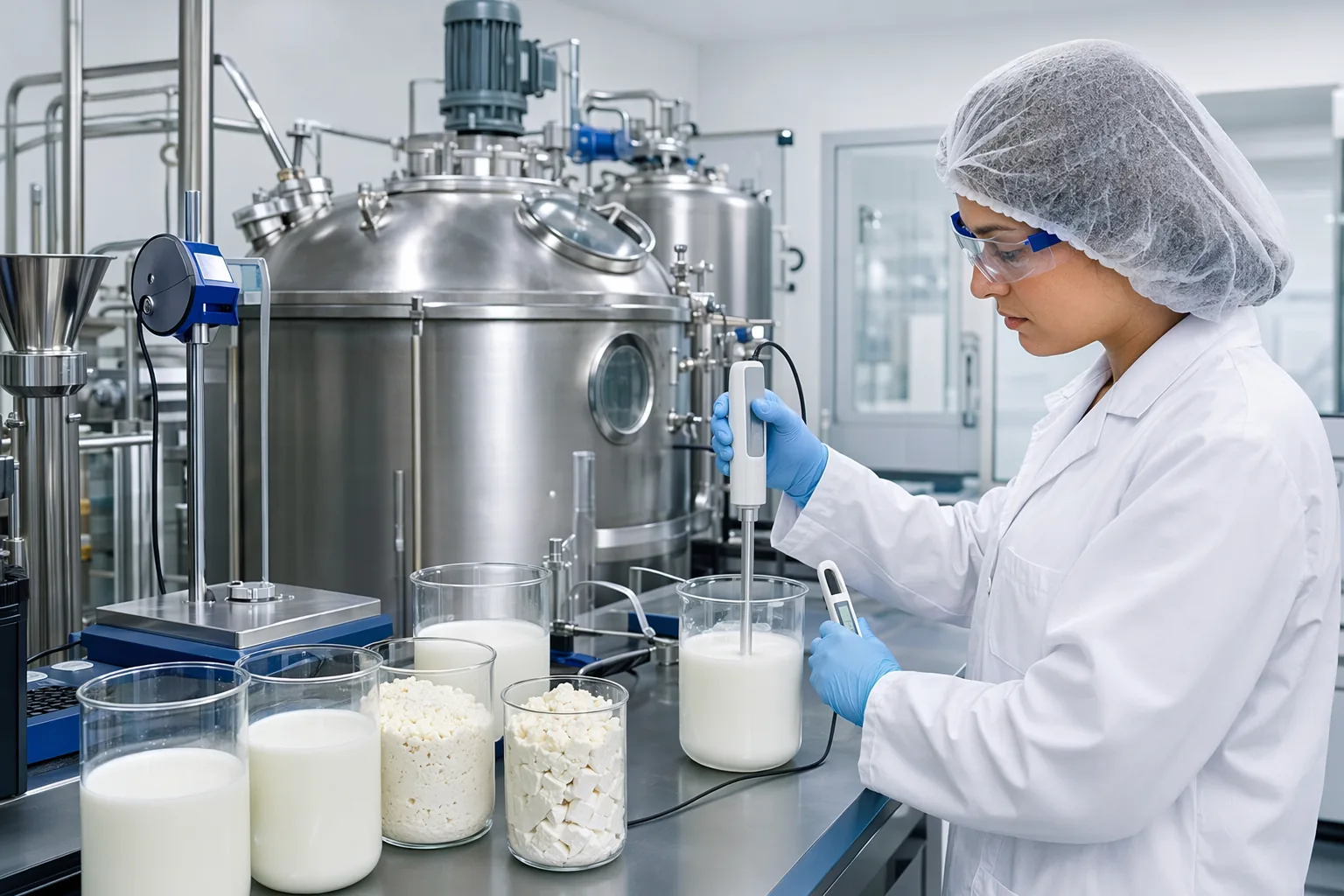
A buyer's guide for dairy manufacturers, milk-protein ingredient producers and the distributors who supply them: what protein deaminase does in dairy systems, how it compares with other protein enzymes, how to run and troubleshoot a pilot, and what to send for a wholesale quote. Cheese-specific guidance is in our protein deaminase for cheese guide.
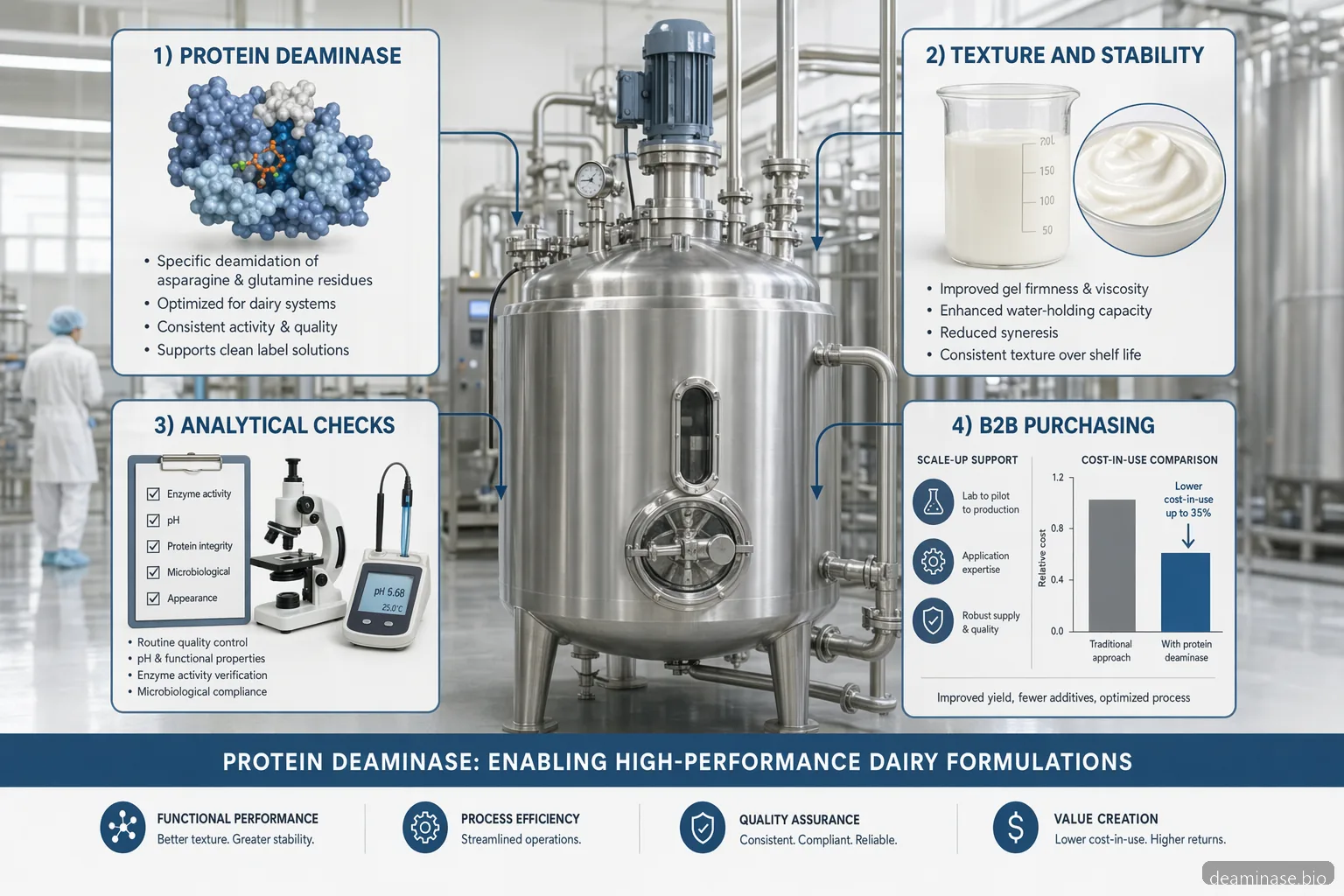
Why Dairy Formulators Use Protein Deaminase
Protein deaminase is an industrial enzyme used for food protein modification, especially where formulators need better hydration, dispersion, emulsification, or gel behavior without changing the declared protein source. In dairy systems, it is typically evaluated for milk protein concentrates, caseinate systems, processed cheese bases, yogurt-style bases, recombined dairy drinks, creamers, and high-protein formulations. The enzyme deamidates glutamine side chains in proteins, forming glutamic acid residues and releasing ammonia. This changes the protein charge profile and can reduce aggregation under selected conditions. For buyers searching for a protein deaminase supplier for dairy, the key question is not only enzyme activity, but whether the supplier can support formulation trials, scale-up, documentation, and consistent logistics. Results depend on substrate, heat history, pH, ionic strength, solids level, and downstream processing, so controlled validation is essential.
Useful for selected dairy protein functionality challenges • Often discussed as protein glutaminase in technical literature • Best evaluated through bench, pilot, and plant confirmation
Protein Deaminase Versus Protease and Transglutaminase
Protein deaminase, also called protein glutaminase, targets glutamine residues in proteins without intentionally cutting peptide bonds. Proteases break peptide chains and can change viscosity, bitterness and texture more aggressively. Transglutaminase cross-links proteins and is chosen to raise gel strength. Pick protein deaminase when the problem is dispersion, solubility, sedimentation or emulsion stability rather than binding. Enzymes named cytidine or threonine deaminase act on nucleosides and amino-acid metabolism; they are not dairy protein-modification enzymes and should not be confused with this product.
Protein deaminase modifies charge and functionality. • Protease modifies chain length and may create peptides. • Transglutaminase cross-links proteins. • Nucleic-acid deaminases are not dairy protein-modification enzymes.
Setting Up a Dairy Trial
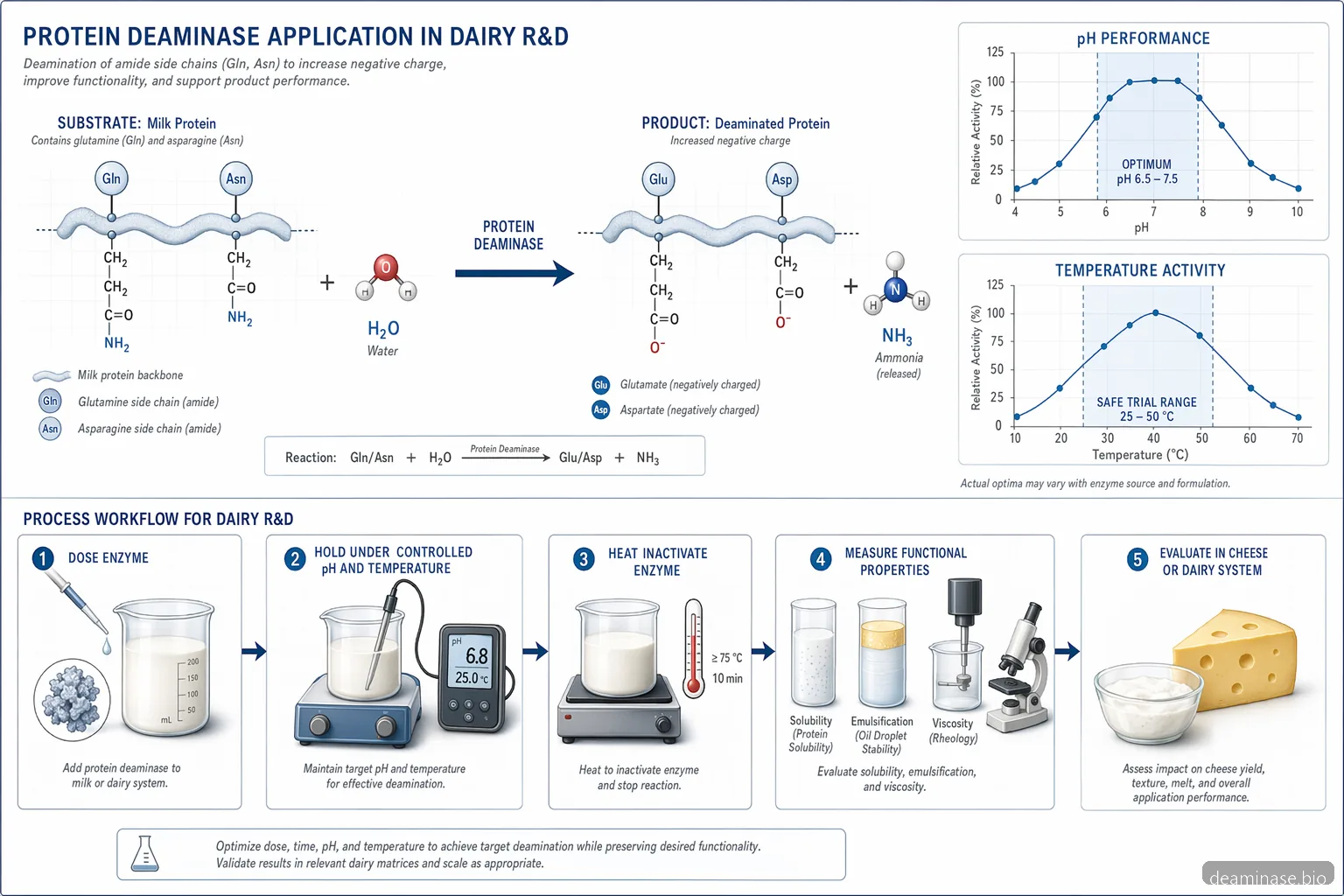
Treat the protein in a controlled hydration or premix step before final heat treatment, homogenization or fermentation. The product specification lists an optimum of pH 5.0 to 7.0 and 40 to 55°C; confirm the working window for your matrix and follow the technical data sheet for the dosing basis. Dose on enzyme activity per gram of protein, run a zero-enzyme control and at least three levels, and select the lowest dose that reaches the functional target. Hold time is set by the result, not the clock. After treatment, use a validated heat step if the formulation requires the enzyme to be inactivated.
Confirm pH, temperature, dosing basis and hold time from the data sheet • Run untreated and heat-inactivated controls • Track ammonia release or degree of deamidation where feasible
Applications in Dairy Systems
When sourcing a protein deaminase supplier for cheese or broader dairy use, match the enzyme evaluation to the actual product objective. In processed cheese, cheese sauces, and dairy spreads, trials may focus on melt, emulsification, firmness, oiling-off, and texture stability. In high-protein beverages or recombined dairy systems, the target may be better dispersion, lower sedimentation, or improved mouthfeel. For yogurt-style or cultured dairy bases, formulators should test enzyme treatment before fermentation and confirm that modified proteins do not negatively affect culture performance, acidification curve, or final texture. Industrial protein deaminase dairy projects should include sensory review because protein modification can influence flavor perception, salt balance, and cooked notes. The best supplier discussions include the exact dairy substrate, total protein, fat level, mineral profile, heat process, and target shelf life.
Cheese: melt, emulsification, firmness, and oiling-off • Dairy beverages: dispersion, viscosity, and sedimentation • Cultured bases: acidification, gel structure, and sensory
Troubleshooting: When Solubility Does Not Improve
Common causes are low delivered activity, the wrong dosing basis, pH outside the effective range, too short a hold, poor mixing, or proteins that are already heavily heat-denatured or mineral-bound. Check the actual tank temperature, the pH at reaction temperature, the protein content and the enzyme's storage history. Do not transfer a dose from plant protein, noodles or cheese into fluid dairy without recalculating it. If the texture becomes too heavy, reduce the dose, shorten the hold or move the addition later.
Measure pH at process temperature. • Avoid adding enzyme into zones with poor mixing or hot-wall exposure. • Record enzyme lot, activity, hydration method, addition point and hold time.
Quality Control and Analytical Checks
Protein deaminase performance should be measured with both analytical and application-based QC. At bench scale, teams may monitor pH drift, viscosity, soluble protein, particle size, water-holding capacity, emulsification stability, and degree of deamidation. Ammonia release can be used as an indirect reaction marker, but it should be interpreted with the specific dairy matrix and baseline nitrogen profile. Finished products should be evaluated for texture, heat stability, phase separation, flavor, color, and shelf-life behavior under expected storage conditions. For procurement, request a COA for every batch, plus the TDS and SDS before trial approval. The COA should identify activity, lot number, production date or retest date, storage conditions, and relevant microbiological or contaminant tests offered by the supplier. Specifications should be confirmed before commercial ordering.
Use both lab assays and finished-product performance tests • Verify enzyme activity and lot traceability on the COA • Compare results against an untreated control and process control
Supplier Qualification for B2B Buyers
A reliable protein glutaminase supplier for dairy should support more than shipment of enzyme powder or liquid. Ask for a current TDS, SDS, COA format, allergen information, origin statement, recommended handling, storage stability, and activity definition. Confirm whether the enzyme preparation contains carriers, stabilizers, salts, or preservatives that may affect dairy labeling or formulation. For regulated food manufacturing, your internal QA team should review whether the enzyme is suitable for the intended market and product category. Avoid relying on broad claims without documentation; instead, compare supplier data, application support, batch consistency, and responsiveness during troubleshooting. The same qualification approach applies when comparing a protein deaminase supplier for plant protein, a deaminase enzyme supplier for dairy, or a protein deaminase supplier for noodles, because activity, purity, and application support vary by source.
Request COA, TDS, SDS, allergen, and handling documents • Confirm activity units and recommended storage conditions • Review carriers and formulation aids for label impact
Scale-Up, Cost-in-Use, and Purchasing Strategy
After bench screening, move to pilot validation using the same mixing order, solids content, pH adjustment, temperature ramp, reaction hold, and inactivation step planned for production. Scale-up can change enzyme contact, heat transfer, shear, and residence time, so do not assume bench results will transfer directly. Calculate cost-in-use based on enzyme activity delivered per kilogram of finished product, not only price per kilogram of enzyme preparation. Include yield improvement, reduced rework, stability gains, processing time, and any added QC or inactivation cost. For commercial buying, align forecast volumes, minimum order quantities, lead times, shelf life, packaging size, and cold-chain or dry storage needs. A strong protein deaminase supplier for dairy will help design trials that produce decision-ready data for R&D, QA, operations, and procurement. The powder is packed in 1 kg, 5 kg and 25 kg fiber drums; pricing and freight are quoted per order. For a quote, send the product and activity grade, the quantity (kg or drums, one-off or recurring), the destination country, and the dairy product and protein you will treat. Ingredient distributors and resellers can ask for recurring-volume quotes.
Evaluate cost per finished unit, not only enzyme price • Confirm pack size and shelf life • Send product, quantity, destination and application with every inquiry
Technical Buying Checklist
Buyer Questions
In many food industry discussions, protein deaminase and protein glutaminase refer to the same functional enzyme class used to deamidate glutamine residues in proteins. Naming can vary by supplier, activity method, and technical document. For purchasing, compare activity units, substrate specificity, recommended conditions, and documentation rather than relying only on the name.
Choose a supplier that can provide a current COA, TDS, SDS, lot traceability, recommended dosing, storage guidance, and application support for dairy matrices. Ask for pilot-scale guidance, activity definition, and information on carriers or stabilizers. Supplier qualification should include QA review, bench validation, pilot confirmation, and cost-in-use comparison before commercial approval.
There is no universal dosage because dairy proteins, heat history, solids, pH, and target texture all affect response. Dose on enzyme activity per gram of protein as the data sheet defines it, run several levels against an untreated control, and confirm the final level in pilot production.
Common causes include low enzyme activity, incorrect dosage basis, pH outside the effective range, insufficient holding time, poor mixing, or substrate proteins that are already heavily heat-denatured or mineral-bound. Check actual tank temperature, pH at reaction conditions, protein content, and enzyme storage history. A supplier-supported pilot trial can help separate enzyme performance issues from formulation and processing limitations.
Yes, protein deaminase can be evaluated in selected cheese, processed cheese, cheese sauce, and dairy spread formulations. Trials usually measure melt, emulsification, firmness, oiling-off, viscosity, and sensory profile. Because cheese systems are highly dependent on minerals, pH, fat, emulsifying salts, and heat treatment, supplier-supported pilot validation is important before commercial use.
Before purchasing industrial protein deaminase dairy ingredients, request the COA, TDS, SDS, allergen statement, activity definition, recommended process conditions, storage and shelf-life data, and lot traceability details. Your QA and regulatory teams should confirm suitability for the intended product category and market. Do not rely on undocumented claims or generic specification summaries.
Send the product and activity grade, the quantity (kg or number of drums, one-off or recurring), the destination country, and the dairy product and protein you will treat. Pack sizes are 1 kg, 5 kg and 25 kg fiber drums; pricing and freight are quoted per order.
Protein-Glutaminase (Protein Deaminase) for Research & Industry
Need Protein-Glutaminase (Protein Deaminase) for your lab or production process?
ISO 9001 certified · Food-grade & research-grade · Ships to 80+ countries
Frequently Asked Questions
Is protein deaminase the same as protein glutaminase?
In many food industry discussions, protein deaminase and protein glutaminase refer to the same functional enzyme class used to deamidate glutamine residues in proteins. Naming can vary by supplier, activity method, and technical document. For purchasing, compare activity units, substrate specificity, recommended conditions, and documentation rather than relying only on the name.
How should a dairy manufacturer choose a protein deaminase supplier?
Choose a supplier that can provide a current COA, TDS, SDS, lot traceability, recommended dosing, storage guidance, and application support for dairy matrices. Ask for pilot-scale guidance, activity definition, and information on carriers or stabilizers. Supplier qualification should include QA review, bench validation, pilot confirmation, and cost-in-use comparison before commercial approval.
What dosage should be used for protein deaminase in dairy?
There is no universal dosage because dairy proteins, heat history, solids, pH, and target texture all affect response. Dose on enzyme activity per gram of protein as the data sheet defines it, run several levels against an untreated control, and confirm the final level in pilot production.
Why did protein deaminase not improve my dairy protein solubility?
Common causes include low enzyme activity, incorrect dosage basis, pH outside the effective range, insufficient holding time, poor mixing, or substrate proteins that are already heavily heat-denatured or mineral-bound. Check actual tank temperature, pH at reaction conditions, protein content, and enzyme storage history. A supplier-supported pilot trial can help separate enzyme performance issues from formulation and processing limitations.
Can protein deaminase be used in cheese formulations?
Yes, protein deaminase can be evaluated in selected cheese, processed cheese, cheese sauce, and dairy spread formulations. Trials usually measure melt, emulsification, firmness, oiling-off, viscosity, and sensory profile. Because cheese systems are highly dependent on minerals, pH, fat, emulsifying salts, and heat treatment, supplier-supported pilot validation is important before commercial use.
What documents should be requested before buying industrial protein deaminase for dairy?
Before purchasing industrial protein deaminase dairy ingredients, request the COA, TDS, SDS, allergen statement, activity definition, recommended process conditions, storage and shelf-life data, and lot traceability details. Your QA and regulatory teams should confirm suitability for the intended product category and market. Do not rely on undocumented claims or generic specification summaries.
What should we send to get a wholesale quote?
Send the product and activity grade, the quantity (kg or number of drums, one-off or recurring), the destination country, and the dairy product and protein you will treat. Pack sizes are 1 kg, 5 kg and 25 kg fiber drums; pricing and freight are quoted per order.
Related: Protein Deamination for Better Food Functionality
Turn This Guide Into a Supplier Brief Request dairy trial guidance, COA/TDS/SDS review, and a protein deaminase quotation for your formulation. See our application page for Protein Deamination for Better Food Functionality at /applications/protein-deamination-applications/ for specs, MOQ, and a free 50 g sample.
Contact Us to Contributehello@mail.deaminase.bio